20/10/2026 18:06
Who Wrote the Parts Advice? Telegram Author Signatures for Cambodian Appliance Shops

A useful appliance-parts post can create an unexpected question: should the customer contact the person who explained the part, or the shop that sells it? For a Cambodian business sharing washing-machine hoses, replacement knobs or filter baskets on Telegram, unclear authorship can send enquiries into the wrong conversation. An employee may know the product but have no responsibility for stock reservations or delivery. Telegram offers different ways to present a channel post’s author. Choosing deliberately helps readers understand who is speaking and where to ask for help. This workflow connects that choice to product promotion, staff responsibilities and an SMM-panel review, without treating a visible name or a rising view counter as proof of expertise, customer interest or sales.
1. Start with the confusion your customers actually face
Consider a hypothetical appliance-parts shop in Phnom Penh. One employee photographs replacement hoses, another checks compatibility questions, and the owner approves prices. Their channel publishes a close-up explaining two connector shapes. A reader recognizes the presenter and sends that person a private request to reserve a hose. The employee is away from the shop, so nobody checks the request against available stock.
The problem is the missing connection between authorship and responsibility. Before changing settings, write down what a reader should understand: who prepared the explanation, who can answer a compatibility question, and who confirms an order. Those roles may belong to different people. Decide which distinctions need to appear publicly and which belong in the shop’s internal notes. This gives the identity setting a practical purpose instead of making it another decorative feature.
2. Understand the three identity choices
Telegram normally presents channel posts under the channel’s name and picture. Its newer author-profile mode also lets administrators choose to post using their own profiles or other channels. Telegram describes these options in its official [Super Channels announcement](https://telegram.org/blog/superchannels-star-reactions-subscriptions).
A traditional administrator signature is different: it displays the administrator’s name without linking to their profile. That distinction appears in Telegram’s [Channels FAQ](https://telegram.org/faq_channels). Profile linking is a separate setting, also documented in the official [signature settings reference](https://core.telegram.org/method/channels.toggleSignatures).
Think of the choices as shop attribution, a name-only credit, or a profile-linked author. For your business, each should answer a different need. Shop attribution suits a shared catalogue voice. A name-only credit can identify a contributor. A linked profile may suit someone who deliberately represents their professional work publicly. None of these choices certifies the accuracy of the product explanation.
3. Choose an identity that matches the enquiry route
Use shop attribution when customers should experience one shared service regardless of who prepared a post. This is often the clearest editorial choice for stock arrivals, opening notices and routine product listings. The shop still needs an internal record of who checked the information, even if that person’s name is absent from the public post.
Consider a name-only signature when recognizing the contributor adds useful context but customers should continue through the shop’s designated contact. Consider a linked author profile only when that person wants the public association and understands the likely attention. Ask whether a customer who opens the profile will find a coherent professional identity and a clear next step. If the shop cannot explain why the profile connection helps the reader, there is little reason to introduce it. Choose based on the service workflow rather than an assumption that personal profiles automatically increase trust.
4. Agree on staff identity before changing the channel
Discuss the proposed public appearance with every employee who contributes posts. Confirm the spelling of their displayed name, the role they actually perform, and whether they want their profile associated with shop content. A familiar nickname may work inside the business but leave new readers unable to distinguish two contributors. Avoid adding titles such as certified technician unless the shop can substantiate them.
For Cambodian readers, keep names and role descriptions recognizable in the language used by the intended audience. Do not improvise different English spellings of the same person across posts. If product labels are in English while explanations are in Khmer, preserve the actual model identifiers and have someone review the surrounding explanation. Public identity should also survive staff changes: agree who will review contact instructions if a contributor changes duties or leaves. This is an operational decision, not a reason to expose personal information unnecessarily.

5. Configure the chosen mode and inspect the sender
Telegram’s documented route for profile-based posting is Channel Settings, then Administrators, with Sign Messages and Show Authors’ Profiles enabled. Its announcement also describes choosing a posting identity through the profile picture in the message bar. Check the available controls in your installed app before proceeding. These instructions come from Telegram’s [Super Channels guide](https://telegram.org/blog/superchannels-star-reactions-subscriptions).
Have the owner or responsible administrator make the agreed change. Prepare a harmless test explaining a sample part, without customer information, prices or reservation promises. Inspect the selected sender before sending. When several identities are available, make that inspection a routine step alongside checking the photograph and caption.
If the controls or resulting appearance do not match your expectation, stop the promotional rollout and resolve the discrepancy. Do not experiment on a time-sensitive stock offer. Keep a brief internal note of the intended mode so the next person does not have to infer the decision from scattered posts.
6. Test what an ordinary subscriber understands
Ask a consenting colleague to inspect the test from an ordinary subscriber account. Give them three practical tasks: identify the business, explain who appears to have written the post, and find where they would ask whether the part fits their machine. Let them describe the route without coaching. A technically correct setting can still produce an unclear customer experience.
For profile-linked posting, check what opens when the author identity is selected. For a name-only approach, check whether the displayed credit is understandable without an explanatory conversation. Also inspect the product image and contact instruction on a small phone screen. Record concrete observations such as 'reader opened the contributor’s profile and could not find the shop contact.' Replace vague judgments like 'looks professional' with the exact point of confusion. Fix that point before repeating the test. The goal is a reader who knows what to do next.
7. Keep the product explanation and buying instruction separate
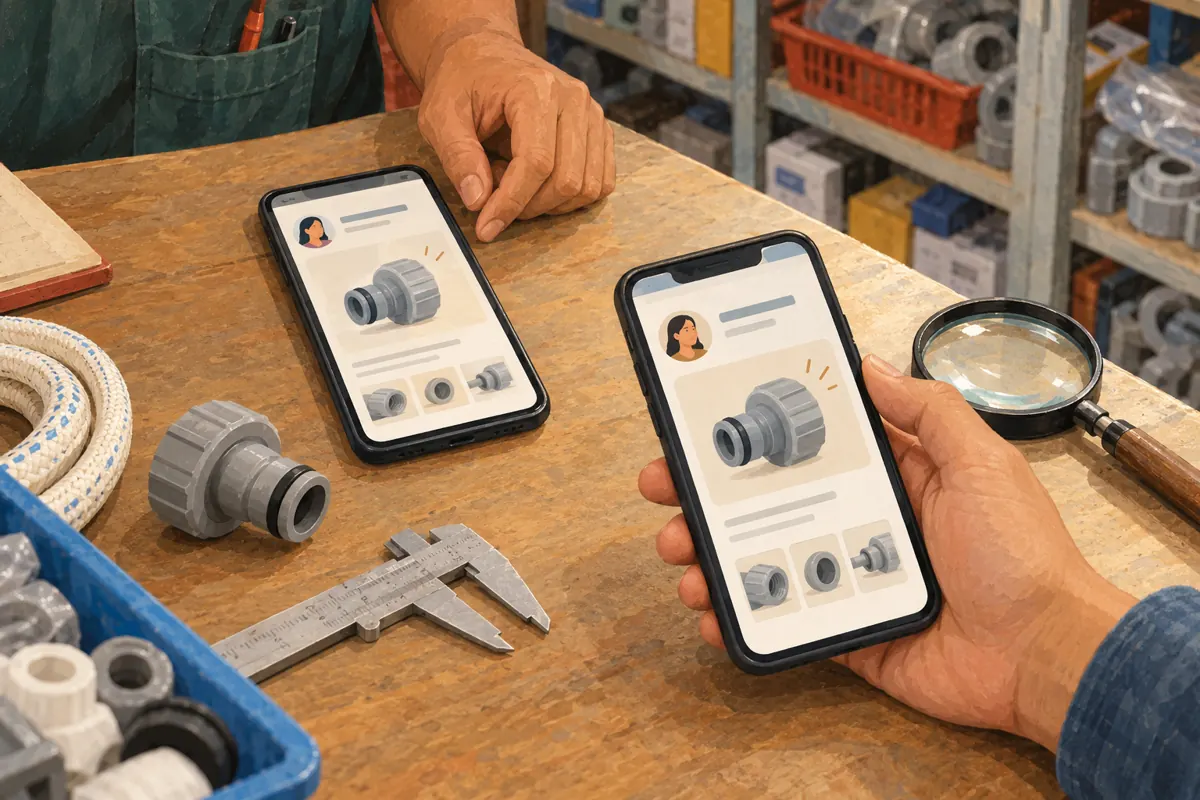
In the hypothetical hose example, the post could explain that the photograph shows one connector style and that the buyer should send the machine model and a clear connector photo for checking. A separate closing sentence should identify the shop’s designated enquiry contact. The contributor credit then answers who prepared the explanation, while the closing instruction answers where the customer should go.
Do not let a named author turn a general demonstration into an implied compatibility guarantee. State the limits of what the photograph establishes. A similar-looking connector may still require further checking, and a public explanation does not reserve stock. Ask only for information needed for the enquiry; a customer’s home address is unnecessary for an initial part comparison. Write the next step so another employee can continue the conversation without reconstructing what the presenter privately promised. This makes the post more useful even if no paid promotion follows.
8. Review an SMM service against the actual objective
The supplied kdmv-smm.com catalogue includes the exact public service name 'Telegram Views - [China]'. Its description is empty. The title identifies a Telegram-view offering with a country label, but the supplied information does not establish its delivery method, audience quality or suitability for a Cambodian appliance shop. Do not reinterpret that label as evidence of Cambodian customers or a verified audience location.
If your objective is correctly routed compatibility enquiries, a view service does not establish that outcome. Purchased engagement is not evidence of genuine interest, sales, official advertising delivery or Cambodian users. A listing also does not establish platform affiliation or compliance with platform rules. It is reasonable to decide that the service does not answer the business need.
Before considering any request, settle the public post and contact route. Record the exact service and intended destination separately from the author’s personal profile. Never substitute a contributor’s profile link merely because it is prominent on the post.
9. Evaluate enquiry clarity without inventing attribution
After publishing useful content, review the questions that actually arrive. Did customers include the machine model? Did they reach the designated contact? Did staff have to redirect them from a contributor’s private conversation? These observations can reveal whether the wording and identity choice help the shop handle enquiries. Keep the notes brief and avoid copying unnecessary personal details.
Telegram says channel view counts are approximate and include views of forwarded copies. That makes the counter unsuitable as a count of confirmed local prospects. See its [view-counter explanation](https://telegram.org/faq_channels#q-what-does-the-eye-icon-mean).
If a panel service was involved, record that separately from enquiry and order records. Do not claim that a signature change caused a sale merely because both happened during the same week. Product availability, customer referrals and the usefulness of the explanation may also have changed. Report what you observed and what remains unknown.
10. Catch the mistakes that create avoidable work
A common mistake is assuming a signature makes someone responsible for every response. Another is selecting the wrong sender identity while preparing several posts. Teams also create confusion when a contributor’s profile suggests personal availability but the caption directs enquiries elsewhere. Prevent these problems with one agreed posting convention and a visible, consistent contact instruction.
Avoid changing the author presentation, product offer, contact route and promotional activity simultaneously if you want to understand a problem. Resolve the customer-facing ambiguity first. If an incorrect identity was used, inspect the affected post and provide a clear correction where necessary; do not assume changing a setting has repaired every earlier message. Before sharing the post again, check its live appearance. A small final review is more useful than an elaborate identity policy nobody follows during a busy afternoon at the counter.

Frequently asked questions
Should a small shop turn on author profiles for every employee?
Only if each public profile connection serves a useful purpose and the employee agrees to that role. A shared shop identity may be easier when duties rotate. Start with the customer journey: if the reader only needs the shop’s catalogue and enquiry contact, adding several personal destinations can create extra work without improving the explanation.
Can we credit the person who checked a part if someone else publishes the post?
Yes, use a truthful credit in the post’s wording, such as identifying who checked the connector comparison. Do not assume the posting identity represents everyone who contributed. Keep the distinction clear between preparing, checking and publishing. Obtain the contributor’s agreement, and avoid implying qualifications or approvals that the shop cannot support.
Does a visible author make a compatibility claim reliable?
No. Reliability depends on the evidence behind the explanation: the correct product, accurate model information and a suitable checking process. An author identity supplies context. The shop should still distinguish a general demonstration from a confirmed match for a particular machine and explain what additional information the buyer must provide.
What if buyers continue messaging the presenter directly?
Review the caption and the profile journey together. The presenter can explain the shop’s enquiry route and ask permission before handing over relevant details. Do not copy an entire private conversation into a staff group by default. If direct messages keep arriving, reconsider whether linking that profile supports the intended service workflow.
Can a Telegram-view service show that the new author format worked?
No. Service delivery and customer understanding are different questions. Evaluate the format through reader tests and actual enquiry handling, while keeping any purchased activity explicitly separate. A larger counter cannot demonstrate that people recognized the author, understood the connector explanation, lived in Cambodia or intended to buy a replacement part.
Explore the current service catalogue, create an account, or ask a specific question through support tickets.
- Telegram: Super Channels, Star Reactions and Subscriptions
- Telegram Channels FAQ: Administrator signatures and channel view counters
- Telegram signature settings: channels.toggleSignatures
Prepared with AI assistance. Illustrations explain the workflow and do not represent customer results.