19/10/2026 16:14
What Did the Guest Mean? A Telegram Translation Workflow for Cambodian Guesthouses

A room video can attract attention while the conversation it starts remains difficult to handle. A guest writes in an unfamiliar language, Telegram produces a readable translation, and reception must decide whether the message asks about availability, changes an existing reservation, or simply requests directions. For a Cambodian guesthouse promoting its rooms through social media, that distinction matters more than a larger engagement count. This workflow explains how to use translation as a reading aid, verify the details that affect a stay, and decide whether the enquiry process is ready for more promotion. All guest scenarios below are hypothetical.
1. Define the decision before translating
Start with the operational question: what must reception understand before taking the next step? For a new enquiry, that might be arrival date, departure date, number of guests and sleeping arrangement. For an existing reservation, it might be whether the guest wants to change something or only asks whether a change is possible. Treat these as different conversations even when the translated wording looks similar.
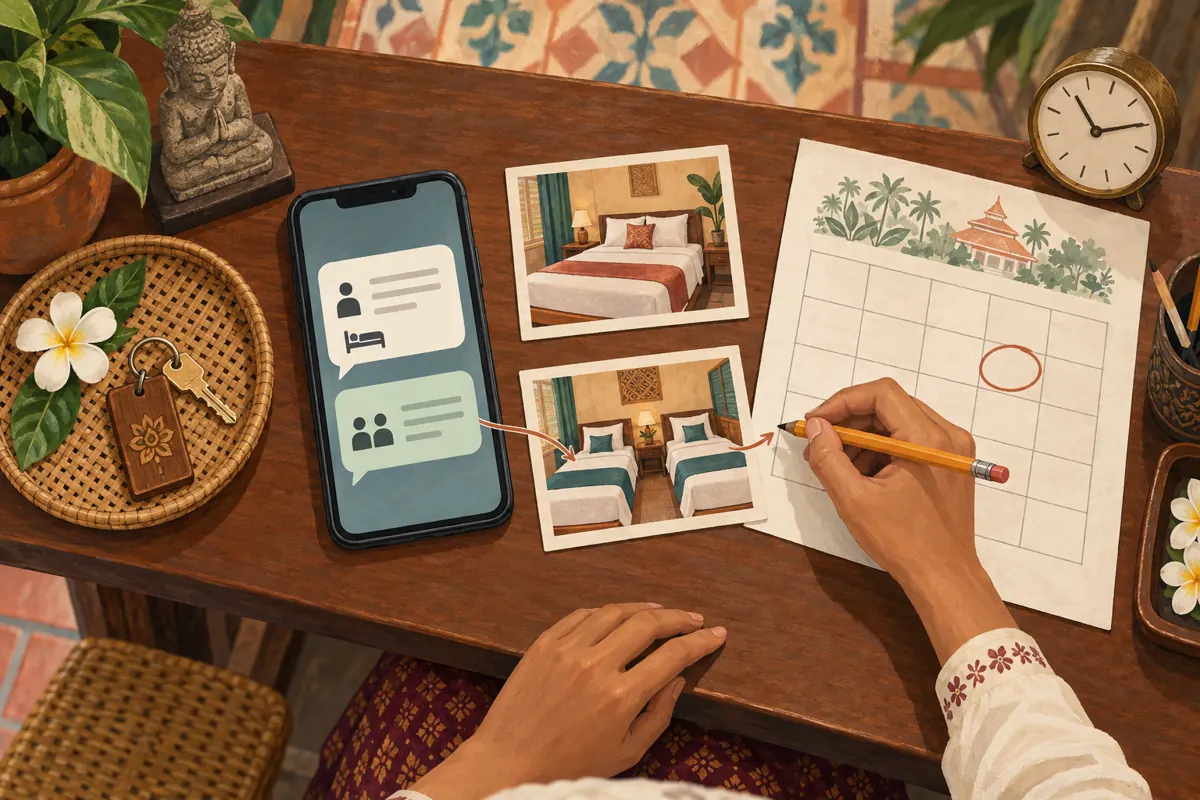
In a hypothetical Siem Reap guesthouse, a message appears to say that two friends want another bed. That could mean separate beds in one room, an extra bed, or an additional room. Reception should mark the sleeping arrangement as unresolved rather than selecting the most convenient interpretation. A useful translation workflow ends with a clear next action: answer, ask a focused question, or seek language help. It does not end merely because the text looks fluent.
2. Test individual-message translation on the reception device
Telegram’s official message-translation guide describes enabling translation in Settings > Language, then selecting a message and using Translate. Languages excluded from translation can affect whether that option appears. Telegram also notes that available languages depend on the phone’s operating system. Check the actual reception device before promising staff that a particular language pair will work.
Use a harmless practice message containing an ordinary room question. Confirm that staff can find the translation, identify the target language and return to the original wording. If Khmer is unavailable in the relevant configuration, use another language only when the staff member understands it well enough to check the answer. Otherwise, arrange help from a competent speaker. Keep the initial exercise separate from a live guest conversation so troubleshooting does not become an accidental booking commitment.
3. Choose between a single message and the surrounding conversation
Telegram’s official guide to translating entire chats distinguishes individual-message translation, available to all users, from Premium translation of whole chats, groups and channels. The latter uses a translation bar and offers language controls. That distinction concerns convenience; it does not establish whether a particular translation captures the guest’s intention.
For a short question, begin with the relevant message. For a reply such as 'only the second one,' read the earlier options before interpreting it. A translated sentence can be understandable while its reference remains unclear. In a hypothetical Kampot guesthouse conversation, the second option might refer to a room photograph, an arrival time or a pickup arrangement.
Choose the smallest amount of conversation that provides enough context. If staff repeatedly need broader translation, evaluate that need using ordinary enquiries before considering Premium. Do not buy a subscription on the assumption that it will eliminate the need for clarification.
4. Check dates and arrival times separately
Dates deserve their own confirmation because a correct translation cannot resolve an ambiguous original. Avoid carrying a numeric date such as 11/12 straight into the reservation record. Ask the guest to name the month, then repeat the arrival and departure dates in a consistent format. Keep the guest’s stated travel time separate from the time reception has agreed to receive them.
Consider a hypothetical message saying, 'We arrive Friday night at one.' Reception should ask whether that means 01:00 on Saturday and whether the guest needs access to the room immediately. Staff must then check the relevant reservation night and the property’s arrival arrangements. Translation alone cannot establish either.
Use a focused question rather than a long paragraph containing several possibilities. For example: 'Do you mean arrival at 01:00 on Saturday, 14 November?' After the guest answers, confirm the room-access arrangement separately. This prevents a simple acknowledgement from being mistaken for agreement to every condition.

5. Verify room features with concrete descriptions
Room labels are often less precise than physical descriptions. Instead of relying entirely on 'double,' 'twin' or 'family,' describe the number of rooms and beds. For example, a hypothetical reply could say: 'One room with two separate single beds.' Ask the guest whether that matches the request before moving to availability and price.
Use an accurate photograph when it helps distinguish options, but explain what the photograph represents. A picture of one room should not silently promise that exact room if assignments remain undecided. Similarly, an image of a bathroom does not explain whether it is private or shared; state that detail explicitly.
Maintain a short internal reference for recurring property terms, with wording reviewed by someone who understands the languages involved. Include practical distinctions such as stairs, shared bathroom, breakfast inclusion and luggage storage. Keep the reference tied to actual facilities so a polished translation never turns an unavailable feature into an offer.
6. Write replies that remain clear when translated
Give each sentence one job. State what is available, identify any condition, and ask one clear question. Avoid idioms, jokes about payment and vague expressions such as 'we will sort it out.' These phrases make it harder for another person or translation tool to distinguish a promise from an intention to investigate.
A hypothetical draft might read: 'We are checking whether a room with two single beds is available. Your requested arrival date is 14 November. Your departure date is 16 November. Is that correct?' This confirms the request without pretending that inventory has already been checked. Once availability is established, send the actual offer through the property’s normal process.
Check the outgoing message against the original question before sending. Make sure a negative has not disappeared, a requested option has not become a confirmed inclusion, and an estimated arrival has not become a guaranteed check-in time. When money is discussed, specify the currency and what the amount covers.
7. Keep sensitive information out of unnecessary translation
Telegram’s Privacy Policy, section 8.4, says text selected for translation may be shared with Google or Microsoft to obtain the translated version. Staff should therefore understand that pressing Translate may involve processing beyond the visible chat. Avoid translating an entire conversation merely to understand one ordinary room question.
If a guest combines a question with passport information or payment details, ask them to restate the question without those details when practical. Do not forward identity documents to a public group or an unfamiliar translation bot for convenience. Keep any necessary document handling within the property’s established process.
For training, write fictional messages instead of copying guest conversations into shared materials. A fictional example about separate beds can teach the same language issue without exposing a traveller’s identity, itinerary or booking reference. Remove unnecessary personal information from internal notes as well.
8. Know when a person must review the meaning
Escalate when an interpretation could change a cancellation decision, a payment obligation, an accessibility arrangement or a complaint response. Also escalate when the translated message conflicts with earlier details. A second machine translation can suggest another interpretation, but agreement between tools is not the same as confirmation from the guest.
Ask a competent colleague to review the specific uncertainty, sharing only the information needed. 'Does this sentence request cancellation or ask about the cancellation policy?' is a more useful handoff than 'Please translate everything.' If nobody suitable is available, acknowledge the question and explain that the relevant detail needs checking.
Avoid presenting uncertainty as the guest’s mistake. A simple message such as 'We want to make sure we understand your request correctly' keeps the conversation cooperative. Record the unresolved point so the next shift does not treat an unfinished interpretation as a settled booking instruction.
9. Match promotion spending to the actual problem
If guests already reach the inbox but staff cannot resolve their questions, additional attention does not address the immediate problem. Improve the conversation first: clarify the room offer, prepare understandable replies and ensure someone can handle unfamiliar-language enquiries. Promote only the contact route the team is ready to support.
One public catalogue entry is named 'Telegram - Bot Start ~ Cancel Enable ~ Max 100k ~ 50k/day ~ 𝐍𝐎 𝗥𝗘𝗙𝗜𝗟𝗟'. Its category identifies a bot-start service, while the supplied description adds no explanation. That listing does not document translation, reservation handling or guest qualification. Treat the embedded quantities and speed wording as catalogue claims, not verified performance or evidence of suitable travellers.
An SMM panel order is also separate from Telegram’s own subscription features and advertising products. Purchased engagement is not evidence of genuine interest, sales, ad delivery or Cambodian users. If the business need is language support, choose a language-support solution; do not substitute a count-based service because both happen to involve Telegram.
10. Rehearse the complete enquiry before promoting it
Run a small rehearsal using fictional enquiries: an ambiguous arrival date, a request for separate beds and a question about changing a reservation. Have one staff member act as the guest and another handle reception. Check whether the receptionist reaches the correct next step without making an unsupported promise. Include the device and language settings staff will actually use.
Review the resulting messages together. Look for missing conditions, unanswered questions and replies that require the guest to guess what 'yes' would confirm. Revise the wording where confusion occurs. Keep a brief note of the problem and the revised response so the exercise improves the shared process.
After promotion begins, record meaningful operational outcomes: whether an enquiry was understood, whether essential details were confirmed and whether the guest completed the property’s booking process. Keep those observations separate from panel delivery records. An enquiry can be handled well without becoming a booking, and a higher public count cannot explain why a guest chose a room.

Frequently asked questions
Do reception staff need Telegram Premium to translate a guest’s message?
Telegram documents individual-message translation for all users and whole-chat translation as a Premium feature. Start by testing individual messages on the actual device. Premium may make longer conversations more convenient, but it does not establish translation accuracy or replace confirmation of important details.
What should staff do if Khmer is not available as the target language?
Check the available options on that device rather than assuming every installation supports the same languages. Use another language only if the staff member understands it confidently. Otherwise, seek help from a competent speaker and keep the booking decision pending until the meaning is clear.
Can a thumbs-up settle an ambiguous room request?
Do not rely on it when the preceding message contains several questions. Restate the particular arrangement, such as one room with two separate single beds, and ask the guest to confirm that point. Then check any remaining dates, conditions or availability separately.
Should the guesthouse advertise that it answers every language?
Only describe support the team can actually provide. Access to a translation button does not demonstrate fluent service in every language. State the languages staff handle reliably, and explain when other enquiries may need additional checking. This gives guests a realistic expectation before they message.
Would buying Telegram bot starts prove that the translated booking process works?
No. A bot-start delivery record does not show whether someone understood a room offer, wanted accommodation or completed a booking. Test the conversation with clearly labelled fictional scenarios, then review actual enquiries through appropriate business records. Keep purchased activity separate from those conclusions.
Explore the current service catalogue, create an account, or ask a specific question through support tickets.
- Telegram: Reactions, Spoilers, Translation and QR Codes — Message Translation
- Telegram: Profile Photo Maker, Translating Entire Chats, Emoji Categories and More
- Telegram Privacy Policy — Section 8.4, Translation of Chats, Channels and Specific Messages
Prepared with AI assistance. Illustrations explain the workflow and do not represent customer results.